Shrine or Temple? How to Tell Them Apart in 15 Seconds — and Pray the Right Way
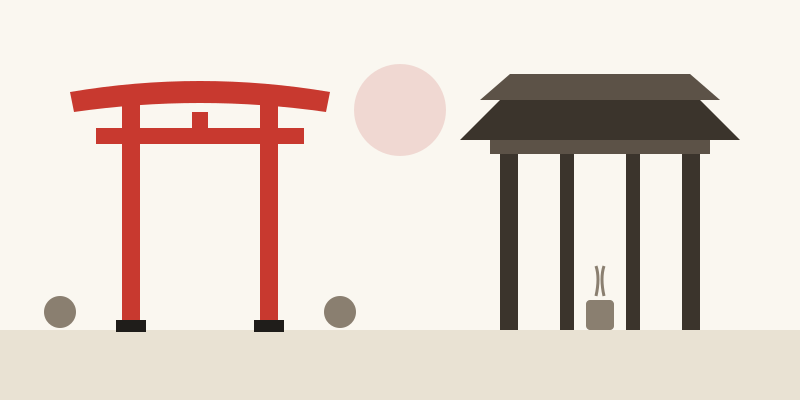
The short answer: a shrine is a home for the gods of Shinto, and a temple is a home for the Buddha. And most Japanese people visit both.
Japan has about 80,000 shrines and about 76,000 temples (Agency for Cultural Affairs). That is more than the number of convenience stores (about 56,000), so if you travel in Japan, you will walk past one or the other many times a day. Because they look similar, many visitors wonder: “Which one is this?” Surprisingly, even many Japanese people can’t explain the difference clearly.
Let’s start with a way to tell them apart just by looking at the entrance.
The gate tells you almost everything
A shrine has a torii. It is a gate made of two pillars with two crossbeams on top. Many are painted vermilion (a bright orange-red), but some are plain stone or wood. A torii marks the border: “From here on, this is the gods’ place.”
A temple has a sanmon. It is a wooden gate with a roof. At large temples, two fierce-looking statues called Nio stand on the left and right. They are bodyguards protecting the Buddha.
What is worshipped is different
| Shrine | Temple | |
|---|---|---|
| Religion | Shinto (a belief born in Japan) | Buddhism (born in India, came via China and Korea) |
| What is worshipped | Kami (gods). Mountains, forests, rocks, ancestors and even historical figures can be kami | The Buddha. There are Buddha statues |
| Name ends with | -jinja, -gu, -taisha | -ji, -in |
| People who work there | Shinto priests (kannushi), shrine maidens (miko) | Buddhist monks |
| Guardians at the entrance | Komainu — a pair of stone statues that look like dogs or lions | Nio statues |
Now you know the basics of telling them apart. But few people know that Japanese people use completely different ways of praying at shrines and temples. Clapping your hands at a temple is the most common mistake travelers make.
The rest of this article is for supporters
Read every article in full. Cancel anytime.
or
Already a member or bought this?
Follow for free
Get an email when a new article is published.
Originally written in Japanese and translated with the help of AI.
Suggest a better translation
Found an unnatural or wrong expression? Tell us and we will review it.